Black Money
What is 'Black Money'
Black money is money which is earned through any illegal
activity controlled by country regulations. Black money proceeds are
usually received in cash from underground economic activity and, as
such, is not taxed. Recipients of black money must hide it, spend it
only in the underground economy, or attempt to give it the appearance of
legitimacy through money laundering.
BREAKING DOWN 'Black Money'
Possible sources of black money include drug trafficking, weapons
trading, terrorism, prostitution, selling counterfeit or stolen goods
and selling pirated versions of copyrighted items such as software and
musical recordings.
Black Money is also the name of a
television series hosted by Lowell Bergman that explores the secret
world of bribery in international business.
Black
Black is a description of a positive balance on a company's financial statements. A company would be said to be "in the black" if it is profitable or, more specifically, if the company produces positive earnings after accounting for all expenses. Conversely, a company with negative earnings would be said to be "in the red."
BREAKING DOWN 'Black'
The phrase "in the black" is widely used to refer to the condition of companies that have been profitable in their last accounting period. This term is derived from the color of ink used by accountants to enter a positive figure on a company's financial statements. It is always better to be in the black as this indicates solid business performance.
Black Thursday
Black Thursday is the name given to Thursday, Oct. 24, 1929, when the Dow Jones Industrial Average plunged 11% at the open in very heavy volume, precipitating the Wall Street crash of 1929 and the subsequent Great Depression of the 1930s.
More
recently, "Black Thursday" is also used to refer to the Thanksgiving
holiday in the United States, as more retailers open on Thanksgiving
evening in a bid to get an early start on the frenzied shopping of Black Friday.
BREAKING DOWN 'Black Thursday'
Black Thursday and the consequent market crash of 1929 triggered a
complete overhaul of market regulation of the U.S. securities industry.
These events led to the promulgation of the Securities Act of 1933 and the Securities Exchange Act of 1934.
The
shopping version of "Black Thursday" has led to growing resistance
among employees of retailers, who complain that they are forced to leave
Thanksgiving family dinners early in order to report to work on time.
Many retailers are opening earlier on Black Thursday with every passing
year in order to counter the increasing popularity of online sales.
October Effect
The October effect is a theory that stocks tend to decline during the
month of October. The October effect is considered mainly to be a
psychological expectation rather than an actual phenomenon as most
statistics go against the theory. Some investors may be nervous during
October because the dates of some large historical market crashes
occurred during this month. The events that have given October the
reputation for stock losses have happened over decades, but they include
the Panic of 1907,
Black Tuesday (1929), Black Thursday (1929) Black Monday (1929) and
Black Monday (1987). Black Monday, the great crash of 1987 that occurred
on October 19 and saw the Dow plummet 22.6% in a single day, is
arguably the worst single day. The other black days, of course, were
part of the process that lead to the Great Depression - an economic disaster that stood unrivaled until the mortgage meltdown nearly took out the whole global economy with it.
BREAKING DOWN 'October Effect'
The
October effect is overrated. Despite the dark titles, this seeming
concentration of days is not statistically significant. In fact,
September has more historical down months than October. From a
historical perspective, October has marked the end of more bear markets
than it has acted as the beginning. This puts October in an interesting
perspective for contrarian buying. If investors tend to see a month
negatively, it will create opportunities to buy during that month.
However, the end of the October effect, if it ever was a market force,
is already at hand.
The End of the October Effect
The numbers don't support the October effect.
Some historical events have fallen in the month of October, but they
have mostly stuck around in the collective memory because Black Monday
sounds ominous. Many investors today have a better memory of the dotcom
crash and the 2008-09 financial crisis, yet none of those days were
given the black moniker to bear for their particular month. The Lehman's collapse
happened on a Monday in September and marked a large increase in the
global stakes of the financial crisis, but it didn't get reported as a
new Black Monday. For whatever reason, the media no longer leads with
black days and Wall Street doesn't seem eager to revive the practice
either.
Moreover, an increasingly global pool of
investors don't have the same historical perspective when it comes to
the calendar. The end of the October effect was inevitable, as it was
mostly a gut feeling mixed with a few random chances to create a myth.
In a way, this is unfortunate, as it would be wonderful for investors if
financial disasters, panics and crashes chose to occur only on one
month of the year.
Black Box Model
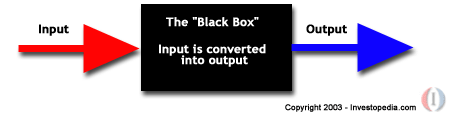
A black box model is a computer program into which users enter
information and the system utilizes pre-programmed logic to return
output to the user.
 BREAKING DOWN 'Black Box Model'
The "black box" portion of the system contains formulas and
calculations that the user does not see nor need to know to use the
system. Black box systems are often used to determine optimal trading
practices. These systems generate many different types of data including
buy and sell signals.
Comments
Post a Comment